The first F-111s, both As and Bs, were completed before the McDonnell-furnished escape module was qualified. The escape modules for these airplanes were therefore equipped with ejection seats.
These were Douglas Escapac seats, probably Model IC. Note that they have two large pull rings for the face curtain rather than just a single one. My guess is that this modification was made to the seat at least in part because Grumman pilots were using a Navy HGU-20/P "clamshell" helmet.
Although it appeared to be a pressure-suit helmet, it was not (the F-111 couldn't get that high anyway). It did away with the oxygen mask and theoretically would be unlikely to come off in a high-speed ejection.
To provide the proper seat relationship to the control stick and throttles, the ejection seat had to be mounted on the aft bulkhead of the crew module, which was located aft of the rear frame of the side hatch.
A panel, identified as the "overhead structure", therefore had to be added to the top of the fuselage to allow the ejection seat a clear pathway out of the cockpit. The edge of this panel is apparent in the picture above and in the following picture of an escape module which is to be completed with ejection seats.
The emergency canopy-removal sequence was complicated.
It was used both for jettisoning the canopy and as the initial step in the ejection process, which was automatically initiated by either crew member pulling the seat's face curtain or alternate ejection handles and had to be completed before seat ejection could occur.
The canopy removal and ejection seat operation were qualified in a sled test conducted by McDonnell. (See
https://www.youtube.com/watch?v=9gyIhOGyGA8)
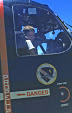
The following still from the sled-test cockpit camera shows the canopy as it is being jettisoned prior to the seats going out.


No comments:
Post a Comment