A Work In Progress
Instrumentation Probe: Some of the F-111Bs were flown with instrumentation probes at some point during development. These provide more accurate air data (static and dynamic pressure, angles of attack and yaw) than sources adjacent to the fuselage. This can be added by CAT 4 R72020 “Shock-sensing probe”.

Inflight Refueling Probe: The Air Force preferred the boom and port concept for inflight refueling because of the much higher flow rate required to minimize the time needed to fill the tanks of its big bombers. The Navy adopted the lighter, simpler probe and drogue concept instead since the flow rates were adequate for smaller aircraft. See https://tailspintopics.blogspot.com/2012/01/f-111b-inflight-refueling-probe.html
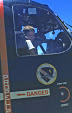
Self Boarding: Except for a brief period, self-boarding was required of U.S. Navy carrier aircraft (the F4D and A4D were exempt). Separate ladders were a nuisance aboard crowded flight decks, particularly given the wind-over-deck velocities sometimes required for launches and recoveries. The F-111’s self-boarding capability was provided by steps integral to a hinged door on the lower side of the fuselage below the cockpit. See https://tailspintopics.blogspot.com/2024/04/f-111b-self-boarding.html
Engine Shroud/Ejector/Tail Feathers: Almost all afterburning engines had a variable-area nozzle located at the back end of the engine. The F-111's TF30 engine included a unusual extension aft of that. My guess is that it was intended to increase mass flow and therefore fuel efficiency when afterburning was not being used. It also may have served as thermal protection for the aircraft structure on either side of the aft end of the engine. For some reason, the shroud/ejector was initially shorter than the production one. Early F-111Bs flew with one or the other before the long one became standard. CAT 4 provides both lengths (and the Revell kit was produced with the short version). Note that the ejector did not have a variable diameter although the later version does appear to be be one, probably because it had "feathers", presumably to accommodate the hoop stress resulting from thermal expansion. Note that the F-111F had a unique shroud configuration.


Boat Tail: Boat tail is a term of art for the aft end of an airplane’s fuselage. Considerable wind tunnel testing initially resulted in a knife-edge end to the fuselage under the vertical fin between the engines. The stabilators were mounted on so-called speed bumps (probably dictated by area ruling) outboard of the engine nacelles. Nevertheless, F-111 drag predictions proved to be optimistic. Most of the problem was diagnosed to be excessive drag created by the aft end of the fuselage. Modifications resulted which were passed on to Grumman for incorporation in the F-111Bs.
The original boat tail tapered to a sharp edge on 970/971/972/973. Note the fuel dump nozzle.

Drag reduction resulted in the addition of a blunt boat tail beginning with 974. Note the small fairing added aft of the arresting hook, presumably to reduce drag. At this point the fuel dump is now flush with the end of the fuselage.

The production boat tail was introduced on 714 ("A" and "B" are not the F-111 designation suffixes but denote the different configurations. Note that the blunt end on 714 is not as deep as 974's.

The fairing aft of the arresting hook on 714/715 was integrated with the fuel dump nozzle:

Arresting Hook: While the USAF F-111s had arresting hooks for emergency landings at fields with an arresting cable, the F-111Bs had a far more robust installation. This is the configuration of the installation on 970/971/972:

973 had a unique boat tail/hook configuration, the knife edge combined with a small fairing after the hook point.

974 had a similar fairing in the same location relative to the hook point.


714/715 had a more robust arresting hook. Also note the wheel added to the tail bumper.

Vertical Fin Tip and Horizontal Tail: The F-111B vertical fin tip was initially identical to the F-111A's. Beginning with 973, it was no longer a fairing for the aft-facing IR detector retained on the F-111A. The modification can be represented by cutting the fairing off longitudinally, fairing it into the fin surface about 2/3ds of the way aft, and raising the white tail light to the top of the modified fin tip.


There were detail exceptions: 971/972 used for Phoenix testing had a camera mounted on the top of the tail and for some reason 973 had a small fairing on top of the fin.

The camera fairing had a rectangular view port:

Fot its at-sea trials, 974 had something mounted on the tip of the fin, probably a camera:

The F-111B stabilators were never fitted with the USAF F-111 threat warning antennas and the speed bump fairing was never removed (it's provided in CAT 4 R72016).


No comments:
Post a Comment